
Services
You’re facing a moment that matters: a new role, a team that needs to become one, a negotiation or a conversation that as to land right. Here’s how I work with you through it, whichever it is.
For the moment the old way stops working.
Who it’s for: leaders navigating a real shift, whether that’s a new title, an expanded mandate, or a role that’s changing shape under them even before anything official does.
What it covers: clarifying your priorities for the shift ahead, mapping the stakeholders who matter, defining your critical path, and building the behaviors the moment asks of you.
Typical format: for an actual new role, one-to-one coaching starting 30 days before your first day and running 90 days after it. For a shift already underway, we start where you are. What’s honestly hard: it’s human nature to never test whether that story actually holds up. Pressure and fear of failure pull your attention toward what’s visible and measurable, the numbers, the changes you can point to. Your team, your boss, your peers, your customers get less attention than they need. And some of what actually needs addressing turns out not to be addressable yet, which takes its own kind of acceptance.
Who this isn’t for: a leader who isn’t actually facing a real shift right now. Someone told to get a coach, rather than one who has chosen to. Someone who can’t yet say, in their own words, why they actually want to reflect and grow, not because someone else asked them to.
What to expect: a start you walk into prepared, and an agenda you’re driving rather than reacting to. Along the way, most clients realize they hadn’t given their stakeholders enough thought, their team almost always, their peers often, the hardest one to see is usually their boss, since “I’m meeting my metrics” feels like proof that relationship is already working.
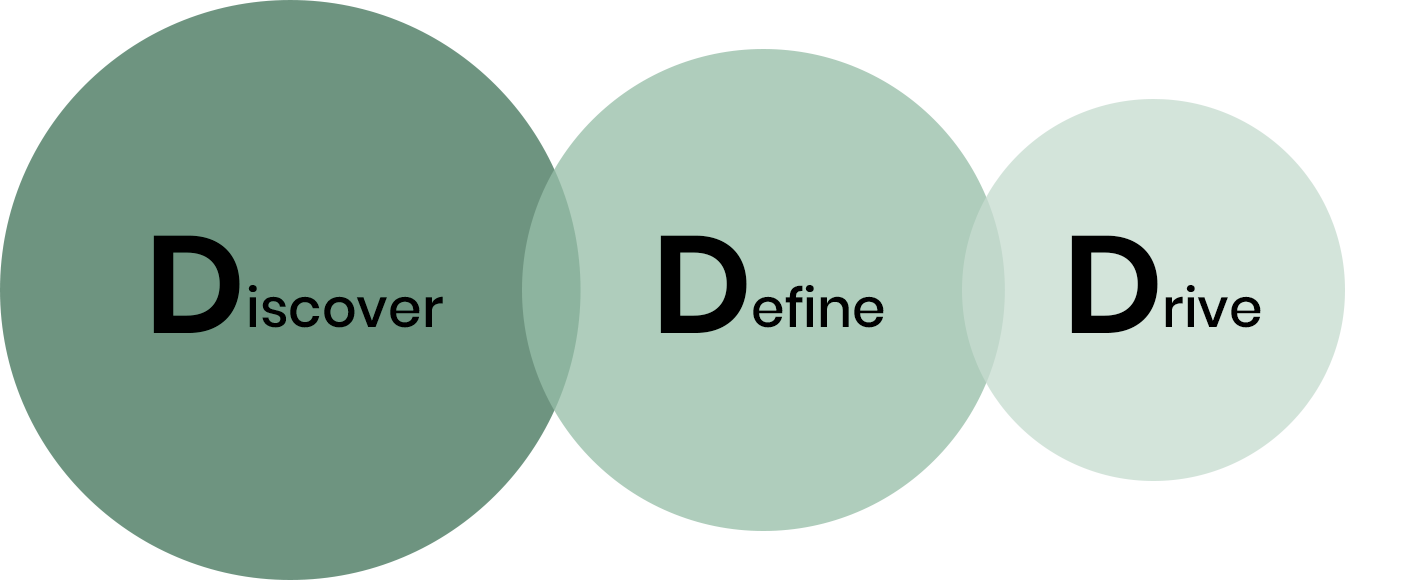

The D³ approach
Discover. Define. Drive. Three phases, one idea underneath them: you can’t fix what you haven’t actually understood, and understanding on its own doesn’t get you through a transition.

the real context, not the official one. Your actual priorities, and the stakeholders who genuinely matter, which is usually a longer list than it first looks.
the critical path. What needs to happen, in what order, and what “done” actually looks like for this specific shift.

to do what the moment asks of you, moving through the plan, not just having it
Simple by design. It’s a method I built through 25+ years of doing this work, and it stays simple on purpose, so it’s something you can actually carry with you, not just something you’re told about once.
Leadership team
coaching & alignment
For teams that look aligned on paper and aren’t yet in practice.
Who it’s for: newly formed leadership teams, teams reshuffled after restructuring or M&A, a team with a substantially changed mandate, or an existing team working with a new leader. This is coaching for a team and its leader together, as one system.¹
What it covers: the trust and honesty inside the team, how leadership functions within it, whether the team still shares a clear sense of purpose and keeps learning as things change, and how it actually works, day to day and with the people around it.
Two ways to work together:
A single session: A short assessment beforehand, for every team member including the leader, tailored to what the team is actually facing, surfaces which one or two of these four are actually holding the team back right now. The session itself will focus on these areas. Optional one-to-one conversations with me, before and after, go deeper still.
A longer journey: The same assessment becomes the map for the whole engagement, one session per area that needs the work, revisited as the team moves. Individual coaching for each team member, and for the leader after every session, runs alongside it.
What to expect: teams going through this commonly report a clearer sense of how each person works by default, and when that default stops serving them, along with a sharper appreciation for what the team can do together that no one could alone. Typically, there are a few moments of joint realization that certain ways of working don’t serve the team (anymore).
What this asks of you: real honesty, in front of colleagues, about things that don’t always get said out loud. Most teams include people ready for that, and people who aren’t, yet. Building enough safety for both is part of the work, not something that has to be true before it starts.
Informed by training in systemic team coaching with David Clutterbuck, and drawing on Peter Hawkins’ work on commissioning and organizational context.
¹ You want a team coaching session without a leader. Let’s talk about how that would look like: [email protected].
Executive & Leadership Facilitation
Sessions ending in agreement, without anyone having to re-sell it on Monday
A strategy day where the loudest voice doesn’t quietly decide everything. A decision the team actually has to own, not just attend the announcement of. A working session that’s failed to land before and needs to work this time.
Before anything starts, a conversation with whoever’s bringing me in, on why an external facilitator matters here, the context, the content, what’s expected of me, what I need to know about the team, and what would make this a good outcome.
In the room, I stay on my feet and move through it rather than stand at the front of it. When something stalls, I name it rather than push past it: “I get the impression we’re not ready to move on from this, what do you need to progress” When someone’s checked out, I move toward them while I keep going, or bring a neighbor into the conversation, most of the time that’s enough on its own. In a large group, especially one where English isn’t everyone’s first language, the same few voices tend to dominate while others hold back. Smaller groups change that, I can draw out the ones who want to speak and rein in the ones who don’t need more airtime, and the shift shows up almost every time.

What’s honestly hard: real tension between people in the room sometimes surfaces mid-session, unplanned, unflagged beforehand. That’s hard on me, since I don’t have the background the group does. It’s hard on the people directly involved, and hard on everyone else watching it happen. The upside is it can become the moment something actually shifts, an unspoken tension finally named, or a leader using the next break to work out what to do differently.
Who this isn’t for: anyone expecting me to bring content depth, act as a subject-matter expert, or hand out advice. That’s not the facilitator’s role, and it’s not what I’m there to do. I hold the time we agreed to. About 15-30 minutes before the end, I name what’s been done and what’s still open, and close on something concrete the group has actually agreed, not just a good conversation.
What to expect: by the end, people who arrived as strangers, different functions, different mother tongues, nothing obviously in common but the organization itself, start making plans with each other unprompted. A follow-up call, an offer to compare notes, an idea for serving a shared client together. Every so often, someone who stayed quiet in the big room in the early sessions comes back into it noticeably louder, having found their footing in the smaller group first. Occasionally, one of them even volunteers for something like a role play, unthinkable from where they started. Proven through client offsites. Open to Board and succession conversations as they come up, worth a direct conversation first on whether the format fits.
Negotiation, prepared systematically, not improvised.
Most negotiations go wrong before anyone sits down at the table: poor preparation, no shared framework for the conversation, assuming from the start that one side has to lose. I teach and use an approach grounded in the Harvard Negotiation Project’s work on interest-based negotiation, the thinking behind “Getting to Yes” still one of the most widely taught negotiation frameworks anywhere.
The approach separates what happens before, during, and after: building enough relationship and communication to make agreement possible, working through interests, options, and legitimacy once you’re at the table, and knowing your own alternatives well enough to walk away from a bad deal rather than accept one too quickly.
I first trained in this approach through Deloitte’s negotiation program, co-facilitated by accredited negotiation experts, then co-delivered it myself as an internal facilitator with the accredited negotiation experts for several years.
What’s honestly hard: most people who come to me for this feel outmatched before they’ve even started, certain the other side has done this many times before and is following some sophisticated framework they don’t have access to. A favorite example: a university spin-out negotiating with the professor who contributed the original idea, over equity, when it was the founders who actually built it into something real. That imbalance is what they’re really trying to fix.
Who this isn’t for: someone set on winning the negotiation outright, rather than genuinely
open to a win-win as the right outcome. This approach assumes the other side matters too, if that’s not the goal, this isn’t the right fit.
What to expect: the shift that actually changes things isn’t a better number, it’s realizing this
is still a negotiation between people, not a deal on paper. Once that lands, people walk out of the session genuinely better prepared, and by their own account afterward, get meaningfully better results.
Format: a focused session, with real preparation time built in for participants’ own upcoming negotiations, and live Q&A on what they’re actually facing.